Event Registration
This is the base feature of any event registration software. We have given it a lot of attention to make it as powerful as possible.
This is the base feature of any event registration software. We have given it a lot of attention to make it as powerful as possible.
Attendee registration is a key element of event organization. CONREGO offers a module that enables individual and group registration, combining flexibility, intuitiveness, and automation. With it, you have full control over the registration process.
The registration process in CONREGO consists of several stages, which you can tailor to the Ticket Type. This allows you to create different registration paths – for example, for different attendee groups or various event editions.
The first step is selecting a Ticket Type. This can be done by the attendee, but you can also direct selected attendees straight to the registration form, bypassing the ticket selection. Nothing prevents you from offering some tickets for selection while reserving others only for those who have received an attendee invitation.

The first stage of registration involves filling out the form and selecting services from the offer. Depending on your preferences, you can first present the attendee with the event offer (additional services, welcome packages, themed sessions, separately paid training, etc.) and then the form collecting attendee data, or vice versa.
The registration form provides an unlimited number of fields for attendees to enter their details. With various field types (text field, date field, dropdown list, file upload), you can collect information from attendees exactly in the format you need. To ensure data accuracy, you can also apply masks that enforce a specific data format (e.g., postal code in the format XX-XXX).
The offer is a list of participation options. These can be specific conference days, particular lectures, or something entirely different (e.g., a dinner or a souvenir T-shirt). Each option can have an assigned price, seat limit, and mutual exclusions with other options. This way, you can prevent attendees from registering for two lectures happening at the same time.
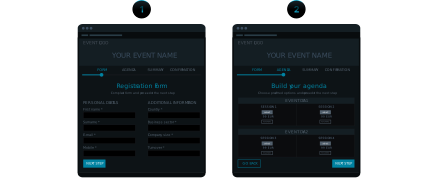
The next stage is the payment form, which appears only for paid events where you are handling ticket sales. It collects only the details that should appear on the invoice. After that, the attendee is directed to the registration summary.
If event registration is integrated with an online payment gateway, then after confirming the details, the attendee will be taken to the payment step.
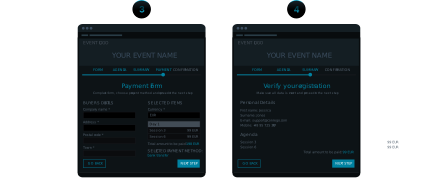
Upon returning, the attendee will see a thank-you page for registration and will receive a confirmation email containing important event information. The content of all these stages can be customized separately for each Ticket Type using Registration Templates.
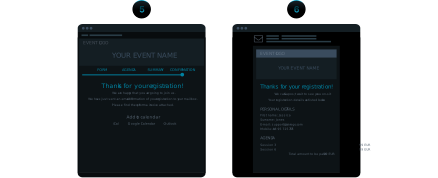
CONREGO provides a flexible group registration system that allows multiple attendees to be registered in a single session. You can apply any pricing rules for groups, giving you full control over discount policies and registration organization.
The registration process in the CONREGO consists of the following steps:
1. Filling out the registration form.
2. Selecting additional services or event-related options (for paid registrations, this includes pricing information).
3. Payment screen containing invoice details and payment method selection (for paid registrations).
4. Reviewing entered data.
5. Registration completion confirmation.
6. Sending a confirmation email with registration and transaction details (if applicable).
Yes. The CONREGO Event Registration Software allows access restriction to invited guests only.
Yes. You can configure the registration process to allow manual approval or rejection of applications.
Yes. In CONREGO, you can set limits for ticket types and service offerings. Once the limit is reached, the participant will not be able to select the given option during registration.
Yes. The "unpaid" status is a final registration status, just like "paid" and "completed." This means unpaid registrations block spots to prevent double bookings.
Yes. Canceling a registration automatically makes the spot available again.
The registration form is the first or second step of the registration process, where participants provide the required details.
The service offering is the first or second step of registration, allowing participants to select additional elements such as lectures, workshops, or accommodations. It can serve as an event agenda or a list of events happening at different times, depending on your needs.
The registration summary is an optional step where the attendee can review entered details and selected services before finalizing the registration.
The payment screen appears only for paid registrations. It contains the invoice details form, payment method selection, a discount code field, and a cost summary.
This is the final, mandatory step of registration, where the attendee receives confirmation of the process completion.
A Ticket Type is a primary classification of attendees registering for an event. By using Ticket Types, we can offer attendees:
- A choice of different participation categories (e.g., Attendee, Speaker, VIP);
- A choice of training session editions (e.g., April Training, June Training);
A Ticket Type must be linked to a selected Registration Template. This link ensures that the given Ticket Type inherits registration conditions set by the associated Registration Template.
A Registration Template is a registration process configuration, including the form, service offering, summary, and email templates.
Yes. The system can be integrated with Google reCAPTCHA v3 to minimize the risk of bot registrations.
Yes, but the configuration of this process depends on the specifics of the event. You can find detailed information in our help article: How to collect info after registration?